

The incretin drugs are one of modern medicine’s genuine breakthroughs. Semaglutide takes the average patient to 15–17% body weight; tirzepatide to roughly 22.5% — and the benefit runs well past the scale.
In landmark trials, semaglutide cut major cardiovascular events by about 20% in people with obesity and no diabetes,[1] and lowered kidney-disease events and deaths in type 2 diabetes.[2] For a field that spent decades with little to offer, this is a different era, and the enthusiasm is earned.
And precisely because they work so well for the average patient, they bring the next opportunity into sharp relief. Optimize hard for an average — scored on weight and glucose — and you begin to see who the average hides. Three groups stand out, and together they are large, growing, and largely unaddressed.
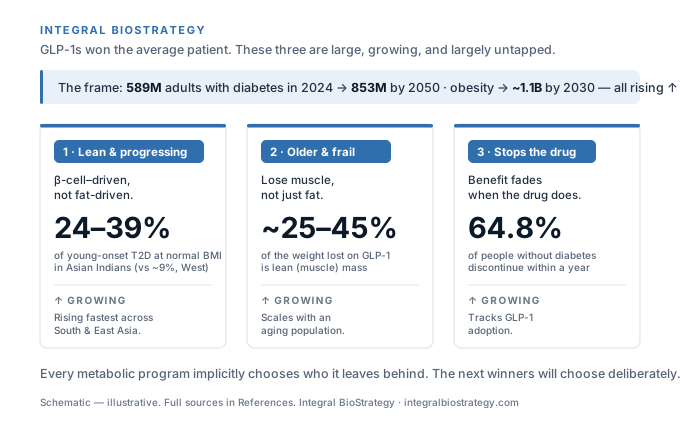
1 · The lean and the progressor Not everyone with type 2 diabetes is there because of excess fat. For a meaningful share, the disease is driven by failing β-cell function, not adiposity — glucose is the downstream readout of a problem upstream of weight. And this is no Western edge case: in Asian Indians, 24–39% of young-onset type 2 diabetes occurs at normal BMI — versus ~9% in white Europeans — a lean, β-cell-driven phenotype common across South and East Asia,[3] where diabetes is rising fastest. This is not a niche left over from the obesity story; it is a large and growing population that drugs built for the obese average were never designed to fix.
2 · The older and the frail Weight is not one thing. A substantial share of the weight lost on incretin therapy is lean mass, not fat — roughly 45% with semaglutide and ~25% with tirzepatide in body-composition studies.[4] We have optimized the magnitude of weight loss and barely measured its composition. For older patients, for the frail, for anyone whose function depends on muscle, “how much” is the wrong question; “what kind” is the right one — and most programs still aren’t built to answer it.
3 · The patient who stops These drugs suppress the disease; they don’t resolve it — and the benefit lasts only as long as the dose. In the STEP 1 trial extension, people who had lost 17.3% on semaglutide regained two-thirds of it within a year of stopping, and their cardiometabolic gains drifted back toward baseline; the investigators concluded that ongoing treatment is required to maintain the effect.[5] Yet most don’t stay on: within a year, 64.8% of people without diabetes — the weight-loss use case — discontinue.[8] A therapy that works only while taken, taken by a minority a year on, defines a maintenance problem the field has mostly waved at.
Underneath all three is the harder point. These drugs suppress weight and glucose; they have not been shown to modify the underlying disease. We have known since UKPDS that on every glucose-lowering therapy, control and β-cell function deteriorate progressively[6] — getting the number down was never the same as halting the disease. Which raises the question the field has not answered: if controlling glucose doesn’t stop the disease, what does? That is the conversation worth leading — and the one this work means to open.
None of this is an argument against incretins; it is the opposite. They worked well enough to reveal what they don’t fix, and that remainder is where the next decade of metabolic medicine sits: muscle-preserving combinations,[7] durable maintenance, and disease-modifying approaches for the patient whose disease was never primarily about fat. The need is large, growing, and today largely untapped.
For anyone developing or investing in a metabolic asset, the question is no longer “how much weight does it take off?” Every program implicitly chooses who it leaves behind. The ones that win next will have chosen deliberately — and will know exactly who that is, and what their asset is meant to change.
The trials behind this piece
| Trial | Published | What it showed |
|---|---|---|
| UKPDS[6] | 1995 | Type 2 diabetes is progressive — glycaemic control and β-cell function decline on every therapy. |
| ADOPT[6] | 2006 | Glucose-lowering monotherapy loses durability within a few years. |
| STEP 1 (extension)[5] | 2022 | A year after stopping semaglutide, about two-thirds of the lost weight returned. |
| SELECT[1] | 2023 | Semaglutide cut major cardiovascular events ~20% in adults with obesity and no diabetes. |
| FLOW[2] | 2024 | Semaglutide cut kidney-disease events ~24% and lowered death in type 2 diabetes with chronic kidney disease. |
| Body composition (meta-analysis)[4] | 2024 | GLP-1 weight loss includes lean (muscle) mass, not only fat — the composition, not just the amount. |
References
- SELECT — Lincoff et al., N Engl J Med 2023. doi:10.1056/NEJMoa2307563. Semaglutide reduced cardiovascular death, MI, or stroke (HR 0.80) in overweight/obesity without diabetes.
- FLOW — Perkovic et al., N Engl J Med 2024. doi:10.1056/NEJMoa2403347. Reduced major kidney-disease events (HR 0.76) and all-cause death in type 2 diabetes with chronic kidney disease.
- Siddiqui et al., Diabetologia 2022. doi:10.1007/s00125-022-05671-z. Non-obese type 2 diabetes across Asia reviewed in Chuang & Tan, J Biomed Sci 2017, doi:10.1186/s12929-016-0307-7.
- Body composition — Jiao et al., Diabetes Obes Metab 2024 (meta-analysis of 19 RCTs; lean reductions sizeable, but lean-mass percentage comparable to controls). doi:10.1111/dom.16012. The by-drug lean fraction is ~45% with semaglutide and ~25% with tirzepatide — Ryan, Rev Endocr Metab Disord 2025, doi:10.1007/s11154-025-09967-4.
- STEP 1 trial extension — Wilding et al., Diabetes Obes Metab 2022. doi:10.1111/dom.14725.
- UKPDS 16, Diabetes 1995 (PMID 7589820) — progressive loss of β-cell function on all therapies; durability also fails over time, ADOPT, Kahn et al., N Engl J Med 2006, doi:10.1056/NEJMoa066224.
- Muscle-preserving approaches in development — myostatin/activin-pathway inhibition (bimagrumab) and GLP-1 combinations with glucagon or amylin; reviewed in Ryan, Rev Endocr Metab Disord 2025, doi:10.1007/s11154-025-09967-4.
- Persistence — Rodriguez PJ, Zhang V, Gratzl S, et al., JAMA Netw Open 2025;8(1):e2457349. doi:10.1001/jamanetworkopen.2024.57349. Within one year, 64.8% of adults without type 2 diabetes (46.5% with) discontinued GLP-1 therapy (125,474 US adults).
- Diabetes prevalence and projection — International Diabetes Federation, IDF Diabetes Atlas, 11th ed., 2025. diabetesatlas.org (PMID 40874767). 589 million adults with diabetes in 2024, projected to 853 million by 2050. (Exhibit.)
- Obesity projection — World Obesity Federation, World Obesity Atlas 2025. worldobesity.org. ~524 million adults with obesity (2010), projected toward ~1.1 billion by 2030. (Exhibit.)
Valdez IA. GLP-1's Forgotten Patients. Integral BioStrategy Research; June 2026. integralbiostrategy.com/insights/forgotten-patient/ doi: 10.5281/zenodo.20713109
© 2026 Integral BioStrategy · CC BY 4.0 — free to share & adapt with credit