

At fifty-four, she has four diagnoses and none at all — four organs each named, the disease beneath them unnamed.
Her blood sugar is creeping up. Her blood pressure needs two drugs to hold. Her knees ache, her sleep is broken and she wakes unrested, and a routine panel once flagged her liver enzymes — a flag no single specialty owned. Across a single year she sees a primary-care physician, a cardiologist, a hepatologist, and a sleep specialist. Every appointment is competent; every note is correct. The cardiologist manages her pressure and her risk; the sleep specialist fits a machine to her apnea; someone, eventually, orders the scan.
Her primary-care physician does see the whole of her — she is the one reading each specialist’s note and holding the parts in one place. But the moment a problem surfaces, the only move the system offers is a referral: each piece sent outward to a specialist whose guidelines and trials were drawn one organ at a time. The integration happens, and then, at the very next step, it comes apart. She is not falling through the cracks. She is being seen too clearly — gathered into a whole, then scattered back into parts, again and again.
That is the strange part. Nothing went wrong. Each clinician did the job in front of them, and did it well. The fragmentation is not a failure of care; it is the shape of the system doing exactly what it was built to do.
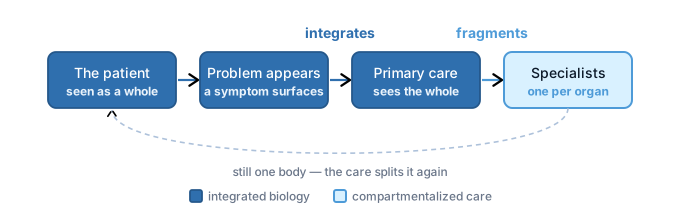
This shape — integrate, refer, fragment, repeat — has deep roots, and real value: medicine learned to study disease by dividing it, and it learned each part superbly. But this is the system’s own logic: it turns its best integrator into the instrument of fragmentation. What the clinic enacts at the bedside was settled long before, in how the evidence itself was made — the machinery we trust to turn biology into evidence was built the very same way.
The trial as a single-organ lens
Each one chose a primary endpoint belonging to a single field: hemoglobin A1c for diabetes, ejection fraction for heart failure, biopsy for the liver, creatinine for the kidney. The design of the evidence assumed a drug would do one thing, in one organ, for one specialty’s patients. The trial was a lens pointed at a single organ system, deliberately excluding the rest.
The body never agreed. A metabolic signal may begin in the gut, the islet, or adipose tissue, but it rarely stays there. It reaches the liver, the muscle, the kidney, the vessel wall, and the appetite centers of the brain, where it shapes hunger, satiety, and reward. A drug that changes how the kidney handles glucose can bend the trajectory of heart failure — even when the trial was never built to see it. The body does not organize disease by specialty. It organizes disease through connected physiology.
The evidence catches up to the body
For decades this was true mostly in principle. What has changed is that the evidence now makes it impossible to treat as background. SELECT was a cardiovascular trial of semaglutide in people with obesity and established heart disease but no diabetes — and it cut major cardiovascular events by about a fifth, in patients who would once have been seen through an obesity or primary-care lens. FLOW was a kidney trial of the same drug in diabetic kidney disease, and it cut major kidney events by roughly a quarter: a nephrology result, funded because of diabetes, in a medicine first known for weight loss. The trials were designed with a specialty in mind. The results answered across organs.
Metabolic disease, in other words, is not five unrelated diseases. It is one connected biology expressed in different tissues, noticed by different specialists, captured in different billing codes, and studied through endpoints that were rarely designed to see the whole.
There is already a name for the overlap — metabolic syndrome — but it concedes only that these conditions keep company; it still treats them as separate things that coincide. The cross-organ trials say otherwise: one biology surfacing in many tissues.
The new translational gap
The bench-to-bedside gap — mechanism to first approval — is the one the field has spent a century learning to close. The harder gap now sits elsewhere. In metabolic disease — and likely across much of medicine — it runs between compartmentalized evidence and integrated biology: between the way we organize evidence and the way the body crosses organs, systems, and specialties.
The irony is that we have never had more ways to measure the body — genomics, biomarkers, imaging, continuous glucose monitors, wearables — and less agreement on how to assemble them into one coherent picture. For a long time the challenge was to find the biology: to name the receptor, the pathway, the signal. That phase was hard, and it produced decades of work.
But biology is no longer scarce. Every conference and every pitch deck surfaces another elegant mechanism. The hard part is no longer finding the biology; it is deciding which mechanisms belong together, and which endpoints — across which organs — tell a coherent story about where a patient is heading. For a century, medicine earned clarity by dividing: one organ, one specialty, one endpoint, one label. The evidence is now pushing the other way — a shift the field has not yet fully absorbed.
It would not be the first field to absorb it. Oncology spent a decade making a version of the same shift: it stopped sorting cancer only by the organ where a tumor began and started sorting it by the biology driving it — then built the trials, diagnostics, and regulatory pathways to match, so a mechanism could be demonstrated once across many cancers instead of re-demonstrated in each. Metabolism has the cross-organ biology for that move but not yet the architecture. Within diabetes, the field has already lived a smaller version of the shift — a century organized around glucose, the number, rather than the biology beneath it. How close the analogy runs — and where it breaks, since metabolism works through mechanisms that act on many organs at once rather than a single molecular target — matters as much as the parallel itself.
What history teaches
The pattern is not new; it has shaped every chapter of metabolic medicine, and the lesson is always about translation rather than discovery. GLP-1 and PCSK9 are mirror images: GLP-1’s biology was elegant for years before anyone could turn a gut hormone that cleared the bloodstream in minutes into a drug, while PCSK9’s target was made almost unimpeachable by human genetics, leaving execution as the entire question. MASH is the cautionary tale — the biology was understood long before the field could agree on how to measure success, and that, not the mechanism, is what stalled it.
SGLT2 inhibitors are the gap in miniature — its most complete worked example. Designed to lower glucose, they revealed — once the cardiovascular trials ran — reductions in heart-failure hospitalization, cardiovascular death, and kidney decline that the glucose story could not explain. The biology had already moved through the body. But each of those benefits still had to be re-established in its own prospective trial, in its own specialty, before it could become a label — not because regulators were wrong to demand prospective evidence, but because the evidence architecture had to ask, separately in cardiology and nephrology, what the biology had already begun to answer across organs. The full sequence took a decade, trial by trial; what matters here is its shape. Biology travels through the body at once. Evidence still travels one specialty at a time.
The thread across all of these is constant: discovery is necessary, but translation — what to test, in whom, with which endpoint, and how to read the result — is where value is made or lost. And in metabolic disease, where the biology crosses boundaries by nature, translation increasingly means integration.
The questions worth asking
In a field this crowded, market size no longer says much. Diabetes is large; obesity is large; everyone knows. The serious question is whether a development program can build evidence across the organs its biology actually engages — or whether it will be forced to chase one label at a time. The open questions are the integrative ones. Durability, because most metabolic benefit depends on continued treatment, and the field still lacks rigorous evidence on lower-dose maintenance. Biomarkers, because we still cannot reliably say who will respond, who will regain weight, or who should be on something else. Endpoints, as cardiovascular, renal, hepatic, functional, and durability outcomes increasingly decide whether a therapy changes practice or merely joins a crowded shelf. Each of these is a decision in disguise — for founders, for partners and business development, for investors, and for translational teams.
Knowing what not to claim
One discipline holds all of this together: knowing what not to claim. Overclaiming is seductive — an on-drug benefit described as disease modification, a positive trial treated as an approved indication, cross-organ signals presented as an integrated story before the trials exist to support it. SURMOUNT-1 is the test case: in adults with obesity and prediabetes, three years of tirzepatide cut progression to type 2 diabetes by roughly 93 percent versus placebo — a relative reduction during treatment that stops a room. Yet once the drug was stopped, new diagnoses began to climb and the gap between groups narrowed; a substantial benefit remained, but a benefit on therapy is not the same as a cure. Sophisticated partners, regulators, payers, and clinicians all notice the distance between what was shown and what was claimed. Over time, that discipline is the strategy. It separates the programs taken seriously from the ones that are merely well-marketed.
Where the work is heading
The next phase of metabolic medicine will still depend on discovery — but the discovery that matters is shifting. Finding new parts is no longer the bottleneck; finding how they compose is. And even that is not enough on its own: the value now lives in the architecture that turns an integrated insight into evidence — understanding what the biology means, where it should be tested, how it should be measured, how the evidence can be assembled across the boundaries we inherited, and how honestly it can be positioned. That is the real work of translation — and in metabolic disease, the work of integration, across organs and trials and labels, is now the center of it.
The trials behind this piece
| Trial | Published | What it showed |
|---|---|---|
| SELECT | 2023 | Semaglutide cut major cardiovascular events by about a fifth (~20%) in adults with obesity and established heart disease but no diabetes — a result first seen through an obesity / primary-care lens. |
| FLOW | 2024 | The same drug cut major kidney-disease events by roughly a quarter (~24%) in diabetic kidney disease — a nephrology result, funded because of diabetes. |
| SURMOUNT-1 | 2024 | Over three years, tirzepatide cut progression from prediabetes to type 2 diabetes by roughly 93% versus placebo — a large benefit on therapy that narrowed once the drug was stopped, not a cure. |
Read the companion report — Metabolism as Platform Medicine — a structured, evidence-graded analysis of disease burden, commercial footprint, evidence architecture, and strategic white space in metabolic disease.
Valdez IA. The Translational Gap in Metabolic Disease. Integral BioStrategy Research; June 2026. integralbiostrategy.com/insights/translational-gap-metabolic-disease/ doi: 10.5281/zenodo.20684096
© 2026 Integral BioStrategy · CC BY 4.0 — free to share & adapt with credit