

Metabolism as Platform Medicine
Why the next strategic frontier is not discovery alone, but evidence architecture across organs, endpoints, and markets.
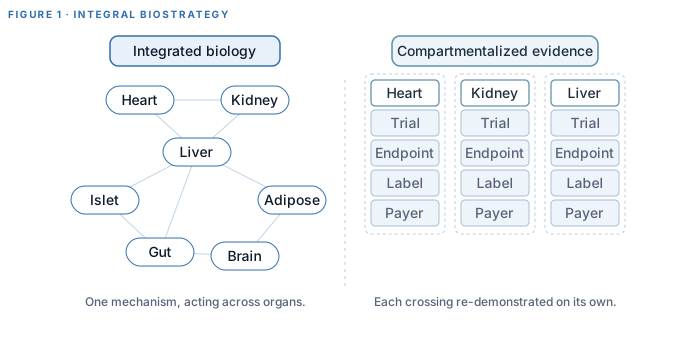
Metabolic medicine was built one organ at a time, and that specialization is what made today's opportunity visible: the deeper each domain looked — glucose handling in diabetes, hemodynamics in heart failure, filtration in the kidney, fibrosis in the liver, appetite and adiposity in obesity — the more often the same biology reappeared. Yet evidence is still generated through the specialties, endpoints, indications, and payer pathways built to study those organs separately. The biology is integrated; the evidence that certifies it is not. We frame this as metabolism as platform medicine — a strategic lens rather than a regulatory category, one that treats the shared mechanism as the unit of strategy, regardless of the organ it was first studied in.
The consequence: advantage is shifting from discovery to the architecture of evidence. A program designed for cross-organ benefit from the outset is more defensible than one that re-establishes the same biology indication by indication — an edge that's real but bounded by the strength of the evidence, not the breadth of the biology.
From discovery to integration
Three facts now sit together that did not a decade ago. The mechanisms are validated. The cross-organ effects are reproducible in large trials. And the institutions that generate and reward evidence are still organized by organ.
That third fact is the thesis of this report. The translational gap in metabolic disease is no longer only the familiar bench-to-bedside gap between a mechanism and a first approval. The harder gap is between compartmentalized evidence generation and integrated biology: between the way evidence is organized by specialty, organ, endpoint, indication, and label, and the way metabolic biology crosses organs, systems, and specialties.
In a structured scan of academic, consulting, venture, trade, and patent sources conducted in June 2026, we did not identify prior field-level use of this framing.9 We offer it as an interpretation, not a discovery and not an established regulatory category, and it builds on the cross-organ clinical frameworks already emerging rather than replacing them.1011
Scale, biology, and budgets are colliding
The case for treating metabolism as a platform is not that the disease burden is large. It is that scale, biology, assets, and budgets are now converging across boundaries that were built to keep them apart.
Start with the scale of the disease. An estimated 589 million adults were living with diabetes in 2024, over 90% of it type 2.12 Chronic kidney disease affected roughly 788 million adults globally in 2023.13 Cardiovascular disease caused approximately 19.2 million deaths in 2023 and remains the leading cause of death worldwide.14 An estimated 890 million adults were living with obesity in 2022.15 An estimated 1.3 billion adults may have metabolic dysfunction-associated steatotic liver disease, though that figure varies by diagnostic criteria: modeled estimates fall near 16%, while some meta-analyses run closer to 38%.16
The overlap is the real point. These are not six separate epidemics; to a large degree they are the same patients, counted in different clinics — the person with type 2 diabetes who also carries obesity, kidney decline, heart-failure risk, and liver fat. Yet that patient is studied, regulated, and reimbursed as if each condition stood alone. Scale raises the stakes; the overlap is what makes the problem strategic rather than merely large, because a single mechanism can now touch several of these conditions at once.
Cross-organ drugs forced the recognition. When one molecule earns benefit in cardiology, nephrology, and hepatology, no single specialty's frame captures everything it does — and clinical medicine has begun to catch up. In 2023, the American Heart Association defined cardiovascular-kidney-metabolic (CKM) syndrome;10 the emerging cardio-renal-hepatic-metabolic (CRHM) framing extends the same logic to the liver.11 These frameworks validate the biology — they describe how to stage and manage a patient whose disease crosses organs — but they do not tell a company how to generate evidence for a cross-organ asset, a regulator how to review one, or a payer how to value benefit that lands in more than one budget. Adjacent commercial work stops at the same boundary: McKinsey's Metabolic Health Initiative (2025) frames the opportunity through a wellness and health-economics lens, not a drug-development one.17
A deeper question sits underneath these frameworks. Nosology — the discipline that decides how diseases are defined and grouped — has long treated these conditions as a cluster. “Metabolic syndrome,” and now CKM, are names for the observation that they keep company. But a cluster still counts its members as separate diseases that co-occur. The cross-organ evidence increasingly supports a stronger reading: that these are, in large part, one connected biology expressed in different tissues, not several diseases that happen to coincide. The strategic argument does not need that stronger reading to win. Reclassifying disease is slow, contested, and beside the commercial point. What matters is the asymmetry the debate exposes — the biology is already described as more unified than the evidence system that tests and approves drugs against it, and that gap widens as cross-organ data accumulate. Whether the field settles on syndrome, cluster, or single disease, the evidence architecture should track the biology, not the inherited label.
The silos are not an accident, and they will not dissolve on their own. Regulatory review is organized into divisions defined by organ and indication; reimbursement runs through specialty-specific budgets; trial endpoints were standardized within specialties long before any single molecule spanned all three. Each structure was rational for the questions it was built to answer. Together, they now lag the biology — and closing that distance, from integrated biology to integrated evidence, is what the rest of this report examines.
What oncology built, and metabolism has not — yet
The gap here is not biological. It is architectural, and oncology shows what closing it can look like.
Over roughly a decade, oncology organized itself around one premise: that cancers are often best understood by shared mechanism and biomarker, not only by organ of origin. The FDA established an Oncology Center of Excellence in 2017.6 FDA guidance on biomarker-driven master protocols lets multiple therapies and sub-studies share infrastructure, control arms, and patient-assignment logic.18 A companion-diagnostic infrastructure grew alongside, and a strategic vocabulary developed in which "platform" companies were a recognized category.
The clearest embodiment came in the tissue-agnostic approval. On May 23, 2017, the FDA cleared pembrolizumab for any unresectable or metastatic solid tumor that is microsatellite-instability-high or mismatch-repair-deficient — the agency's first approval defined by a molecular feature rather than the organ of origin.35 Larotrectinib followed on November 26, 2018, for NTRK-fusion-positive solid tumors, the first tissue-agnostic targeted therapy.36 In both, the evidence supported treatment across organ sites defined by a shared biomarker rather than by tissue of origin — the regulatory system recognizing molecular context over location.
The analogy to oncology is useful, but it is not exact. Oncology's platform logic often rests on biomarker-defined populations, where a shared molecular alteration can guide therapy across tumor types. Metabolism's current platform logic is more often revealed through mechanism pleiotropy and cross-organ outcomes: one mechanism acting across several disease domains. That difference matters. It is why patient selection, decision-grade biomarkers, and companion-diagnostic infrastructure remain open questions in metabolic disease rather than solved infrastructure. The comparison to oncology is not a claim that metabolism should copy oncology directly. It is a way to show what mature evidence architecture can look like once a field begins to organize around mechanisms that cut across inherited categories.
Metabolism does not have to look outside itself for the pattern; it has already lived a smaller version of it. For most of its modern history, diabetes was organized around a single number. Glucose was the definition, the diagnostic threshold, and the treatment target — the metabolic counterpart to the organ of origin, the inherited surface label the field built itself around. But glucose was never the whole disease. The United Kingdom Prospective Diabetes Study showed that intensively lowering it reduced microvascular complications yet produced no significant reduction during the trial in the macrovascular events that kill most patients; the cardiovascular and mortality benefit emerged only years later, in long-term post-trial follow-up — the so-called legacy effect.3738 And the disease beneath the number is not one thing: type 2 diabetes spans lean and obese, insulin-deficient and insulin-resistant phenotypes, and data-driven analyses now resolve adult-onset diabetes into several distinct subgroups with different complication trajectories.39 The modern cross-organ drugs closed the loop on the lesson — SGLT2 inhibitors and GLP-1 receptor agonists deliver cardiovascular and renal benefit through pathways only partly about glucose at all. Targeting the number, like classifying a tumor by its site, captured something real and missed the biology underneath. It is the same move oncology made, already run once inside metabolism's own borders.
Metabolism has the integrated biology, but not yet the architecture. The report's central claim is therefore deliberately calibrated:
The clearest counter-example to any claim of outright absence is SYNERGY-OUTCOMES: an early master protocol in metabolic disease, a single large trial of roughly 4,500 participants studying both retatrutide and tirzepatide in patients with MASLD at risk of major adverse liver outcomes, now enrolling.7 It does not contradict the thesis; it confirms the direction of it. The field is already building the architecture it lacks, which is why the strategic window is open now rather than hypothetical.
A single trial, though, is not yet a system. A mature platform architecture rests on roughly four pillars:
- a disease-spanning regulatory home that reviews across organ divisions;
- a library of master protocols that let assets share controls and infrastructure;
- a companion-diagnostic infrastructure that assigns patients by biomarker rather than by organ;
- a shared strategic vocabulary in which platform assets are understood, valued, and funded as a category.
Metabolism is early on each. There is, as yet, no disease-specific Center of Excellence, no established library of master protocols beyond early entrants, no mature companion-diagnostic infrastructure, and no settled cross-organ regulatory guidance.
The effect shows up in how indications are won. Major label expansions in these classes have generally been supported by their own indication-specific outcomes or Phase 3 programs19 — pipeline logic applied to platform-like biology. This is not a failure of regulation. Organ-specific outcomes trials are how a system built on prospective, compartmentalized evidence confirms benefit responsibly, and that bar has protected patients. The strategic opening is not to lower it but to anticipate cross-organ benefit earlier within it, because integrated biology has had to be demonstrated one trial at a time even when the mechanism was already understood.
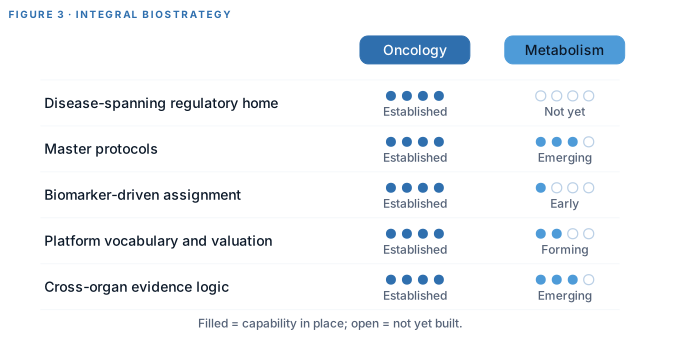
Table 1 · Cross-organ trial evidence by therapeutic class
| Class / Trial | Domain | Primary result | Source |
|---|---|---|---|
| SGLT2 — EMPA-REG OUTCOME | Diabetes + CVD | HR 0.86 for MACE | [1] |
| SGLT2 — CREDENCE | Diabetes + CKD | HR 0.70 renal composite | [20] |
| SGLT2 — DAPA-HF | Heart failure (reduced EF) | HR 0.74 | [2] |
| SGLT2 — EMPEROR / DELIVER | Heart failure (reduced/preserved EF) | Composite reductions; DELIVER HR 0.82 | [22] [21] |
| GLP-1 — SELECT | Cardiovascular (obesity, no diabetes) | HR 0.80 for MACE | [3] |
| GLP-1 — FLOW | Kidney (diabetes + CKD) | HR 0.76 | [4] |
| GLP-1 — ESSENCE | MASH | 62.9% resolution vs 34.3%; 36.8% fibrosis improvement | [5] |
| GLP-1 — SURMOUNT-OSA | Obstructive sleep apnea | FDA-approved indication, Dec 2024 | [23] |
The binding constraint, in other words, is now architectural. The biology rewards a platform approach; the evidence system still rewards a pipeline approach. A company that recognizes this early, and designs evidence to capture cross-organ benefit on purpose, is positioned differently from one that treats each indication in isolation.
The cost of building evidence sequentially
SGLT2 inhibitors show what integrated biology costs when its evidence is built sequentially.
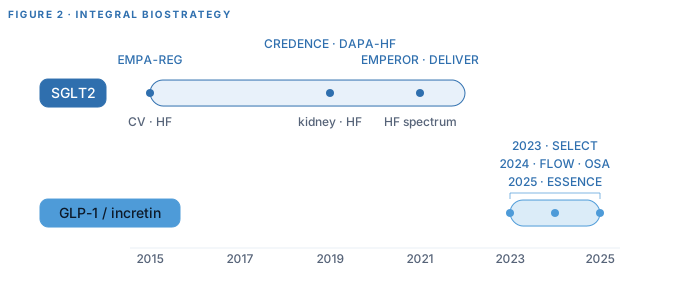
The class was designed to lower blood glucose by blocking renal glucose reabsorption, with modest expected effects on HbA1c, weight, and blood pressure. The original commercial expectation was a niche diabetes therapy. What followed was not anticipated. A cardiovascular safety trial mandated under post-2008 diabetes-drug guidance returned more than safety: a marked reduction in cardiovascular death and heart-failure hospitalization, with event curves separating far earlier than any glucose effect could explain.1 The benefit was real, but it could not be claimed for the patients who would most benefit without dedicated trials in each population.
So the evidence was built indication by indication, across roughly a decade (see Table 1). SGLT2 inhibitors show a consistent class effect across heart failure and chronic kidney disease, each established by its own outcomes trial. By the mid-2020s, guidelines positioned the class as foundational therapy for combined cardiovascular and renal risk, well beyond diabetes.
For development teams, the lesson is that a cross-organ mechanism can create substantial value, but a sequential evidence path pays for it in time, capital, and delayed recognition: roughly a decade and tens of thousands of randomized patients to convert one mechanism into cross-specialty standard of care. The companies that anticipated the cross-organ effects early were positioned to act on them sooner. For any asset with plausible cross-organ biology today, the planning lesson is to design for those effects during early development rather than characterize them after approval.
A mechanism that became a platform
If SGLT2 inhibitors are the historical parable, GLP-1 receptor agonists are the contemporary case: the clearest live example of platform-like biology, and of the evidence lag that still surrounds it.
GLP-1 receptor agonists have shown cross-organ benefit in dedicated Phase 3 trials spanning cardiovascular risk, kidney disease, MASH, and obstructive sleep apnea (see Table 1). The pattern matches SGLT2 — one mechanism demonstrated through sequential organ-specific trials — but compressed in time and increasingly designed rather than discovered. The commercial scale that followed is real: Eli Lilly's tirzepatide alone generated $36.5 billion in fiscal 2025.24
This is exactly where restraint matters, because the GLP-1 story is the easiest in medicine to overstate. Three caveats belong in any rigorous reading.
First, persistence. Real-world GLP-1 persistence has been low, with some analyses finding roughly 14% of patients still on therapy at three years in earlier cohorts, though persistence appears to be improving among more recent initiators.25 Benefit on therapy and benefit over a population's lifetime are not the same thing.
Second, weight regain after discontinuation, where outcomes vary by study context. In the STEP 1 extension, participants regained approximately two-thirds of their prior weight loss within one year after semaglutide 2.4 mg and structured lifestyle intervention were withdrawn.26 Other observational analyses have reported different maintenance patterns, but the populations and treatment conditions are not directly comparable, so durability after discontinuation is best read as unsettled, not resolved.
Third, body composition. Weight lost is not uniformly fat. Lean-mass preservation is moving from footnote to differentiator: in the BELIEVE phase 2 trial, combining bimagrumab with semaglutide limited lean-mass loss to about 2.9% versus about 7.4% with semaglutide alone, with roughly 92% of weight loss coming from fat in the combination group.27
The implication for asset strategy is that durability, persistence, and body composition belong in the evidence plan from the start, not as later additions. A narrative that leads with peak efficacy and treats those three as footnotes understates its own risk; a credible one holds the breadth and the open questions together.
What is moving, and why it matters
Market data should support the thesis, not replace it. The figures below appear sparingly, as context for where capital is concentrating — not as forecasts, and not as valuation commentary. All market-size figures are analyst estimates that vary by scope and methodology, stated as of 2026.
Table 2 · Market estimates (analyst, 2026)
| Segment | Estimate | Caveat |
|---|---|---|
| GLP-1 / incretin | ~$53–63B (2025); ~$130–255B by the mid-2030s | Wide variance by inclusion criteria and scope; long-range figures highly uncertain. [8] |
| SGLT2 inhibitors | ~$13–20B (2025), clustering near $17–18B | Generic erosion underway; range reflects scope/definition differences. [29] |
| MASH pharmacotherapy | ~$8–34B by the early 2030s | Highly dependent on diagnosis rates and access. [30] |
The numbers matter less than the shift they describe. The cardiometabolic market is consolidating from a set of siloed franchises into one space where the same mechanism competes across several budgets at once. Three patterns stand out.
Capital is concentrating around validated cross-organ biology. Revenue sits heavily in a small number of incretin and SGLT2 assets, while the first approved MASH therapy, Madrigal's resmetirom, generated roughly $958 million in its first full year (2025) — early evidence that payers will fund metabolic-liver therapy when benefit is clear.28
New modalities and geographies are entering the same space. Oral incretins arrived in this window: oral semaglutide 25 mg was FDA-approved on December 22, 2025 and launched in January 2026,31 with orforglipron (Foundayo) following on April 1, 2026.32 China, meanwhile, has become a significant source of metabolic out-licensing, reversing the traditional direction of deal flow: mazdutide (Innovent) became the first dual GCG/GLP-1 agonist approved anywhere, cleared by China's NMPA on June 27, 2025,33 and AstraZeneca's January 2026 agreement with CSPC reached $1.2 billion upfront, up to $3.5 billion in development and regulatory milestones, and up to $13.8 billion in commercial milestones — roughly $18.5 billion in total if all are met.34
Integrated biology is now acquired as often as it is built. When large players choose to buy cross-organ mechanisms rather than develop them, much of what they are paying for is the validated, organ-spanning evidence behind the molecule, not the molecule alone.
The practical consequence is that capital is already moving toward cross-organ biology, but the value any program captures still depends on evidence quality, differentiation, durability, and access. Securing the mechanism is only part of the problem; the durable advantage sits in the evidence. None of this is a recommendation about any company or security; it maps where attention and capital are concentrating, and the direction is consistent.
The questions worth answering with evidence
The open questions in metabolic disease are now largely about evidence design, and the useful form of each one names the decision it would change.
Table 3 · Strategic white-space questions
| Question | What it changes | Status |
|---|---|---|
| What durability evidence would change payer behavior on a cross-organ asset? | Asset positioning and reimbursement | Underdeveloped |
| What endpoint would raise regulatory confidence in integrated cross-organ benefit? | Trial design and approval pathway | Becoming feasible (SYNERGY-OUTCOMES) |
| What biomarker would change patient selection rather than describe it? | Population definition and label | No mature infrastructure |
| What maintenance evidence would close the gap between trial efficacy and real-world persistence? | Long-term value and access | Open; oral options now exist |
| What trial design would reduce the need to re-demonstrate the same biology organ by organ? | Capital efficiency and time-to-recognition | Early (master protocols emerging) |
| In MASH, which evidence (fibrosis, hard outcomes, body composition) actually moves prescribing and access? | Differentiation in a crowding class | Early commercial |
The cross-organ endpoint question is where the path is opening: SYNERGY-OUTCOMES suggests the regulatory and operational design is becoming feasible,7 and whoever generalizes it beyond a single trial will shape how the next decade of cross-organ assets is evaluated.
In practice: of these six, the endpoint and durability questions are the two to resource first — they carry the most leverage on approval, payer behavior, and capital efficiency — and a cross-organ program should build them in before single-indication momentum forecloses the option.
The higher-hype items deserve more restraint. Precision metabolic medicine, biomarker-guided therapy, and continuous-glucose monitoring outside diabetes are scientifically interesting but, on current evidence, premature as near-term certainties. They belong here as open questions, not settled opportunities.
A diligence question for each actor
The architecture framing turns into a specific diligence question for each actor. These are questions a serious team should be able to answer before it commits.
Founders and CEOs: Does the evidence plan match the biology? An asset with cross-organ potential, run as a single-indication program, may be underbuilding the very evidence that would make it valuable — and that gap rarely shows up in the pitch.
In practice: if the mechanism is credibly cross-organ, design the cross-organ evidence — endpoints and durability — in from the outset rather than indication by indication; SGLT2 and GLP-1 each had to win every organ with its own trial, and that sequential cost is what a platform-aware plan can pre-empt.
Pharma strategy and business development: Is this asset being valued on single-indication terms or on cross-organ platform terms? The difference is usually evidence that has not been designed yet — a diligence finding rather than a line in the data room.
In practice: value and structure the deal on the evidence still to be designed, not just the current indication — if the biology is cross-organ but the plan isn't, price that missing evidence as work-to-be-done, because the gap is designable evidence, not a discovered asset.
Investors: Does diligence test the evidence architecture, or only the mechanism and the headline data? A validated mechanism with a thin plan for demonstrating cross-organ benefit and defending durability is a more fragile asset than its top-line trial reads.
In practice: score the evidence-architecture plan alongside the mechanism and the top-line data, and treat a validated mechanism with a thin cross-organ/durability plan as a valuation risk, not upside — durability after discontinuation is genuinely unsettled, so a thin plan is more fragile than the headline read suggests.
Translational teams: Are biomarker and endpoint choices being made as core strategy or as downstream execution? In a platform-style field, endpoint design is itself a strategic choice, and deferring it forecloses options later.
In practice: fix endpoint and biomarker strategy early, as a leadership decision rather than late execution — deferral forecloses options, and the biomarker that would change patient selection (not just describe it) is precisely the infrastructure the white-space table flags as missing.
Payer and market-access teams: Can the value framework recognize benefit that lands in more than one budget, or does it carry forward a specialty-silo logic that will undervalue an integrated mechanism and slow its access?
In practice: pressure-test whether your value framework can credit benefit that lands across more than one budget — a specialty-silo framework will systematically undervalue an integrated mechanism and slow access, so the fix is the framework, not the asset.
Across these roles, the underlying question is the same: how integrated biology will be demonstrated and paid for. None of them has a single right answer, and the answer for a single-asset company differs from the answer for a diversified developer. The platform lens does not settle the decision; it makes the question sharper, and a decision made with the cross-organ structure in view is easier to defend than one reached by default.
Where the credibility comes from
These cautions are not formalities. They are where the report's credibility comes from, and in a crowded field that credibility is itself an advantage.
- Benefit on therapy is not the same as benefit after it. A drug that works while taken has demonstrated exactly that, and no more. Durability after discontinuation is a separate question, and in metabolic disease that evidence is genuinely unsettled.
- A positive trial is not a label. It demonstrates an effect in a studied population. It does not, by itself, create an approved indication or a reimbursed use, or establish that the result generalizes.
- Treat market estimates as estimates. The figures here are ranged and dated because analysts disagree depending on definitions. They indicate scale and direction, not settled value.
- A signal across organs is not yet integrated evidence. Observing benefit across several organs does not establish that an integrated development, regulatory, or reimbursement framework is warranted. That requires studies designed to evaluate cross-organ benefit directly. Closing that distance is the work, not the conclusion.
- Platform medicine here is an interpretation, not a designation. It is the lens we propose, not a guidance document or an agreed-upon term. We argue for it. We do not present it as settled.
A report that respects these lines is more useful in a diligence room than one that does not, because it tells a decision-maker where the evidence actually stands.
Our method
Our approach is deliberately narrow and explicit.
We read biology across systems rather than within a single specialty, because the mechanisms that matter in metabolic disease rarely respect organ boundaries. We organize evidence by decision relevance — what a founder, a board, a diligence team, or a development group actually needs to decide — rather than by academic completeness. And we grade every claim: well-supported, plausible, emerging, or unsupported. That grading is the discipline that lets a team build a position it can defend and avoid the overclaiming that quietly erodes credibility in front of regulators, partners, and investors.
Our role is to design evidence architecture. We do not run trials, negotiate payer contracts, or execute transactions.
This report is scientific and strategic analysis. It is not medical, investment, legal, tax, regulatory, or securities advice. Nothing in it guarantees regulatory approval, payer coverage, or commercial outcome, and nothing in it should be read as a recommendation regarding any company or security.
Sources, graded
Grouped by category; each source carries a quality tag and a verified link. Market figures are analyst estimates, dated and directional. Current as of June 2026.
Clinical-trial evidence
- Peer-reviewed EMPA-REG OUTCOME (Zinman et al., NEJM, 2015) — SGLT2 CV/HF benefit (HR 0.86). nejm.org ↗
- Peer-reviewed DAPA-HF (McMurray et al., NEJM, 2019) — HFrEF (HR 0.74). nejm.org ↗
- Peer-reviewed SELECT (Lincoff et al., NEJM, 2023) — CV MACE (HR 0.80) in obesity without diabetes. nejm.org ↗
- Peer-reviewed FLOW (Perkovic et al., NEJM, 2024) — kidney outcomes (HR 0.76). nejm.org ↗
- Peer-reviewed ESSENCE (semaglutide in MASH, NEJM, 2025) — 62.9% resolution vs 34.3%; 36.8% fibrosis improvement; FDA MASH approval Aug 2025. nejm.org ↗
- Peer-reviewed CREDENCE (NEJM, 2019) — renal composite (HR 0.70). nejm.org ↗
- Peer-reviewed DELIVER (NEJM, 2022) — HFpEF/mrEF (HR 0.82). nejm.org ↗
- Peer-reviewed EMPEROR-Reduced (Packer et al., NEJM, 2020) & EMPEROR-Preserved (NEJM, 2021) — HF composite reductions. Reduced ↗ · Preserved ↗
- Regulatory SURMOUNT-OSA — FDA approval of tirzepatide for OSA, December 2024. investor.lilly.com ↗
- Peer-reviewed BELIEVE (bimagrumab + semaglutide, Nature Medicine, 2026; phase 2, n=507) — combination limited lean-mass loss to ~2.9% vs ~7.4% with semaglutide alone; ~92% of weight loss from fat in the combination group. nature.com ↗
- Peer-reviewed UKPDS 33 (UK Prospective Diabetes Study Group, Lancet, 1998) — intensive glucose control reduced microvascular complications; macrovascular reduction non-significant in-trial. pubmed ↗
- Peer-reviewed UKPDS 10-year post-trial follow-up (Holman et al., NEJM, 2008) — emergent reductions in myocardial infarction and all-cause mortality (the “legacy effect”). nejm.org ↗
- Peer-reviewed Diabetes subgroups (Ahlqvist et al., Lancet Diabetes & Endocrinology, 2018) — data-driven cluster analysis (n=8,980) resolving adult-onset diabetes into five subgroups with distinct outcome trajectories. thelancet.com ↗
Public-health burden
- Public-health authority IDF Diabetes Atlas, 11th ed. (2024) — diabetes 589M; 853M by 2050. diabetesatlas.org ↗
- Peer-reviewed GBD 2023 CKD (The Lancet, 2025) — CKD ~788M (2023). thelancet.com ↗
- Peer-reviewed GBD 2023 CVD (JACC, 2025) — CVD ~19.2M deaths (2023). jacc.org ↗
- Public-health authority WHO, "Obesity and overweight" fact sheet (2022 data) — over 890M adults living with obesity. who.int ↗
- Peer-reviewed MASLD: GBD 2023 (~1.3B; 16.1%) pubmed ↗ · meta-analysis trend (~38%) pmc ↗ — figures are definition-dependent.
Regulatory architecture
- Regulatory FDA Oncology Center of Excellence (established 2017). fda.gov ↗
- Registry SYNERGY-OUTCOMES (NCT07165028) — master protocol; ~4,500 participants; retatrutide + tirzepatide; MASLD/MALO; enrolling. clinicaltrials.gov ↗
- Regulatory FDA guidance, "Master Protocols: Efficient Clinical Trial Design Strategies to Expedite Development of Oncology Drugs and Biologics" (2022). fda.gov ↗
- Regulatory Indication-by-indication FDA approvals (representative labels) — major label expansions added through their own indication-specific outcomes or Phase 3 programs. Farxiga (dapagliflozin): approved for heart failure with reduced ejection fraction on May 5, 2020 (the first SGLT2 inhibitor for HFrEF, including patients without diabetes, after the 2014 type 2 diabetes approval; FDA prescribing information, Drugs@FDA NDA 202293), then for chronic kidney disease (April 30, 2021). Wegovy (semaglutide): approved to reduce major adverse cardiovascular events in obesity or overweight on March 8, 2024 (SELECT trial). These histories, alongside the indication-specific trials in Table 1, illustrate that cross-organ benefit has generally had to be demonstrated one indication at a time. FDA: Farxiga CKD ↗ · FDA: Wegovy CV ↗
- Regulatory Pembrolizumab — first tissue/site-agnostic approval. FDA accelerated approval, May 23 2017, for MSI-H/dMMR unresectable or metastatic solid tumors; the FDA's first tissue/site-agnostic indication. fda.gov ↗
- Regulatory Larotrectinib — second tissue-agnostic approval (first targeted). FDA accelerated approval, Nov 26 2018, for NTRK-fusion-positive solid tumors; the first tissue-agnostic targeted therapy. fda.gov ↗
Company financials and approvals
- Company filing Eli Lilly Q4/FY2025 results (Feb 2026) — tirzepatide $36.5B (Mounjaro $22.97B + Zepbound $13.54B). investor.lilly.com ↗
- Company filing Madrigal Q4/FY2025 results (Feb 19 2026) — resmetirom ~$958M (first full year). globenewswire.com ↗
- Regulatory Oral semaglutide 25 mg — FDA approval Dec 22 2025; Novo Nordisk. biospace.com ↗
- Regulatory Orforglipron (Foundayo) — FDA approval Apr 1 2026; Eli Lilly. investor.lilly.com ↗
- Regulatory Mazdutide — NMPA approval Jun 27 2025; Innovent (first dual GCG/GLP-1). prnewswire.com ↗
- Company filing AstraZeneca–CSPC collaboration (Jan 30 2026) — $1.2B upfront; up to $3.5B development/regulatory; up to $13.8B commercial milestones; up to ~$18.5B total if all milestones met. astrazeneca.com ↗ Deal terms only; no financial-risk characterization implied.
Market estimates
- Analyst estimate GLP-1/incretin: Polaris Market Research (~$52.8B, 2025); Fortune Business Insights (~$62.8B); Morgan Stanley (~$190B by 2035). Polaris ↗ · Fortune BI ↗
- Analyst estimate SGLT2: Future Market Insights (~$17.8B); Straits Research (~$13.4B); Global Market Insights (~$20.4B), 2025. FMI ↗ · Straits ↗
- Analyst estimate MASH: DataM Intelligence (~$8.1B 2025 → ~$31.8B 2033); Grand View Research (~$33.8B by 2030). DataM ↗ · Grand View ↗
Originality and adjacent frameworks
- Internal scan Integral BioStrategy structured scan, June 2026 — we did not identify prior field-level use of this framing. A documented scan result, not an absolute novelty claim.
- Peer-reviewed CKM syndrome — AHA Presidential Advisory, Circulation, 2023. ahajournals.org ↗
- Peer-reviewed CRHM (emerging) — Theodorakis & Nikolaou, Biomolecules, 2025. mdpi.com ↗
- Secondary McKinsey Health Institute, "The path toward a metabolic health revolution" (2025) — wellness/health-economics lens; characterization is our interpretation. mckinsey.com ↗
Evidence caveats (real-world)
- Secondary Real-world persistence (Prime Therapeutics; HealthVerity) — ~14% at 3 yr in earlier cohorts; improving in recent initiators. healthverity.com ↗
- Peer-reviewed Weight regain after withdrawal of semaglutide. Trial-extension evidence: Wilding et al., "Weight regain and cardiometabolic effects after withdrawal of semaglutide: The STEP 1 trial extension," Diabetes, Obesity & Metabolism 2022;24(8):1553–1564 (NCT03548935; PMID 35441470) — one year after semaglutide 2.4 mg plus structured lifestyle intervention were withdrawn, participants regained approximately two-thirds of their prior weight loss (11.6 of 17.3 percentage points), with cardiometabolic variables reverting toward baseline. Other observational data: a company-commissioned real-world analysis (nference; 135k+ records; AJMC coverage, Gasoyan) reported different maintenance patterns (~68% maintaining or losing at 6 mo). Populations, treatment exposure, discontinuation status, follow-up, and outcome definitions differ, so these sources are not directly comparable. STEP 1 extension ↗ · ajmc.com ↗
Formatted PDF with endnotes and a source-quality appendix. Free, no sign-up required.
Valdez IA. Metabolism as Platform Medicine. Integral BioStrategy Research; June 2026. integralbiostrategy.com/strategy-reports/metabolism-as-platform-medicine/ doi: 10.5281/zenodo.20683746
© 2026 Integral BioStrategy · CC BY 4.0 — free to share & adapt with credit
The narrative argument behind this report's evidence-graded analysis. Read the essay →
Cross-therapeutic companion When Biology Crosses Categories Before Medicine DoesThe same evidence-architecture lens applied beyond metabolism, with boundary cases where the pattern does not hold. Read the founder report →
Shaping a development plan or evaluating an asset?
If you are shaping a development plan, evaluating an asset, or refining an evidence strategy, Integral BioStrategy works at the boundary between biology, translation, and strategic clarity. Start with a brief scoping conversation.
Request a confidential scoping callPrefer email? [email protected]